Article: Hormones and Herbs: Two Layers of Support
Hormones and Herbs: Two Layers of Support
Written by Adelyn Zhou
KEY TAKEAWAYS:
- Different layers: Hormone Replacement Therapy and Project M address different biological systems. They are tools, not ideologies.
- What HRT does well: HRT replenishes declining hormones and is highly effective for specific symptoms.
- Why symptoms can persist: Many women on HRT still feel anxious or wired because replacing the hormone doesn't automatically retrain the nervous system's stress response.
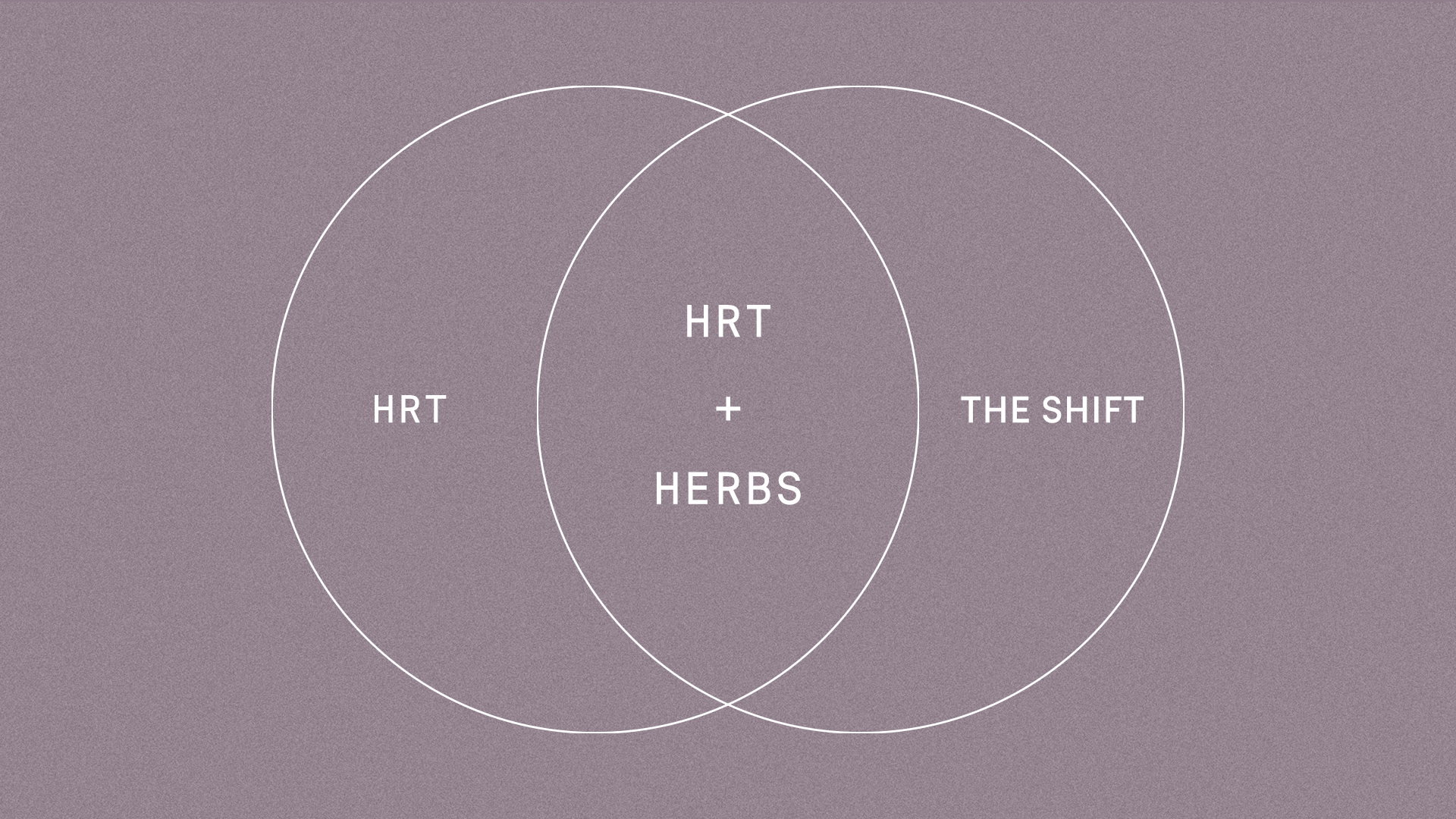
- The integration: You do not have to choose a side. Botanical regulation can be used alone or alongside HRT to support the whole system.
For many women, peri/menopause eventually brings a practical question into focus.
You've learned about HRT. You've heard about natural approaches. You're trying to decide what makes sense for your body, your symptoms, and your medical history.
Peri/menopause is often treated as a single problem with a single solution. But biology is rarely organized that way. Clarity comes from understanding which parts of the system are affected and which tools address which layer.
WHAT HRT SOLVES
Hormone Replacement Therapy is a powerful and, for many women, transformative tool.
When ovarian production of estradiol and progesterone declines, HRT restores circulating hormone levels. In doing so, it reliably reduces hot flashes and night sweats, supports bone density, and maintains urogenital tissue health.
For many women, this change is substantial and immediate. HRT addresses a real hormonal deficit, and it does so effectively. For symptoms driven primarily by hormone loss, replacement can be exactly the right tool.
WHAT CAN REMAIN
There is another experience that is common but often unexpected.
A woman starts HRT. Her vasomotor symptoms improve. Her lab values normalize. Yet she still wakes at 3 a.m. with a racing heart. She still feels anxious without a clear trigger. Her nervous system feels easily overwhelmed.
This is disorienting. Stabilized hormone levels don't always mean a stabilized system.
THE MISSING LAYER: REGULATORY CAPACITY
The answer lies in regulatory capacity: the nervous system's ability to respond to stress or stimulation and then return to baseline. When this capacity is intact, the system activates when needed and settles afterward. When it is reduced, small inputs provoke large reactions and recovery takes longer.
Perimenopause narrows this buffer. Hormonal changes act as a stress test on the HPA Axis (Hypothalamic-Pituitary-Adrenal) — the brain's primary stress-response system. The shifts often occur faster than the nervous system can adapt.
HRT can stabilize hormone levels. It does not automatically rebuild this buffering capacity.
WHY ESTROGEN ALONE DOESN'T ALWAYS SETTLE THE SYSTEM
Estrogen interacts with the brain, but replacing estrogen does not retrain how the stress response operates.
Persistent symptoms often reflect a system stuck in a feedback loop: heightened stress sensitivity, a narrowed window of tolerance, and difficulty settling after activation.
This is why a woman can have appropriate hormone levels and still feel wired, reactive, or exhausted. The issue is not whether enough hormone is present. It is how the system is responding to change.
THE REGULATORY LAYER
This is the layer where Project M operates.
Rather than replacing hormones, the formula works through neuro-endocrine modulation: using adaptogenic herbs like Bupleurum (Chai Hu) and Peony (Bai Shao) to support stress signaling and nervous system tone.
The aim is not sedation or emotional suppression. It is improving the system's ability to tolerate fluctuation without overreacting.
Low-amplitude botanical inputs support the nervous system's capacity to absorb change, interpret it proportionally, and return to baseline more efficiently. This work can happen independently of HRT or alongside it.
HOW WOMEN ACTUALLY COMBINE APPROACHES
In practice, women rarely fit into a single category.
The natural approach: Some use botanical regulation because HRT is medically contraindicated or simply not preferred.
The transitional approach: Some use it when symptoms are present but not severe enough to warrant hormones.
The integrative approach: Some take HRT for bone protection or vasomotor symptoms and add botanical regulation to address the sleep disruption, anxiety, or emotional reactivity that remains.
This is not indecision. It is responsiveness.
In East Asian healthcare systems, this layered approach is standard. Hormonal therapies address one aspect of physiology, while botanical formulas support regulation and tolerance around it.
A MORE USEFUL QUESTION
Rather than asking "hormones or not," a more useful place to start is: which part of my system actually needs support right now.
- If symptoms are driven primarily by hormone loss, replacement can help.
- If symptoms reflect nervous system reactivity, regulation matters.
- If both are true, layering is often the most complete answer.
THE TAKEAWAY
There is no moral hierarchy in peri/menopause care.
Taking hormones does not mean you are ignoring your body. Using herbs does not mean you are avoiding science.
The goal is not to follow a doctrine. The goal is to feel steadier inside your own system.
You have more than one tool. Use them thoughtfully.