Article: How Herbs Become Medicine: Extraction Explained
How Herbs Become Medicine: Extraction Explained
Written by Adelyn Zhou
KEY TAKEAWAYS:
- The "Raw Grind" Trap: Many supplements are simply ground-up roots ("Dust"). Your body struggles to digest raw plant cellulose, meaning you absorb very little.
- The Decoction Difference: Traditional Chinese Medicine was always a liquid extraction, not a solid pill. Boiling releases the bioactive compounds.
- Safety: Aqueous extraction significantly reduces heavy metal transfer compared to consuming raw root powder.
- The "Ghost" in the Machine: We use a closed-loop system to capture volatile essential oils that are usually lost in standard processing.
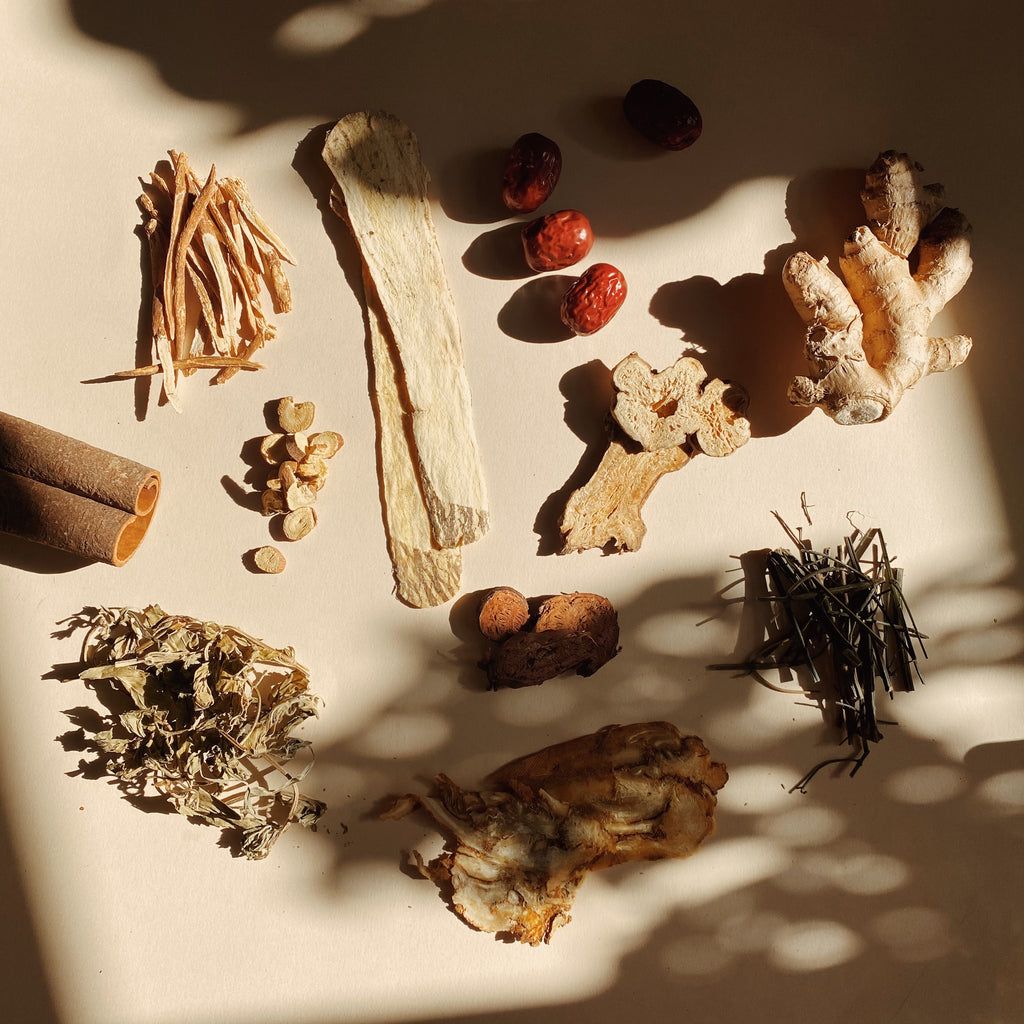
If you walk into a traditional herbal pharmacy in Chinatown, you leave with raw herbs and a set of precise instructions:
-
Cover with water.
-
Bring to a boil.
-
Maintain heat for 45 minutes.
-
Strain the liquid. Discard the fiber.
This wasn't a ritual. It was chemistry.
Traditional Chinese Medicine was never designed to be swallowed raw. It was designed to be extracted.
This article explains the critical difference between raw ground herbs (“dust”) and full-spectrum extraction (“tea”), and why the method of manufacturing matters just as much as the ingredients themselves.
THE PROBLEM WITH RAW-GROUND HERBS
Many modern herbal supplements are made by drying roots and grinding them into a fine powder, which is then encapsulated and sold as the finished product.
It’s convenient. It’s low cost.
And biologically, it’s inefficient.
Roots such as White Peony (Bai Shao) and Bupleurum (Chai Hu) are structurally dense. Their medicinal compounds are embedded inside tough plant cell walls composed largely of cellulose. The human digestive system is poorly equipped to break down raw cellulose, especially in short transit times.
As a result, absorption of active compounds from raw ground herbs is significantly reduced. Much of the fiber—and the phytochemicals trapped within it—passes through the digestive tract without being meaningfully accessed.
A simple analogy helps:
-
Raw grind: Eating a spoonful of ground coffee beans. You get fiber, very little caffeine, and a likely stomach ache.
-
Extraction: Drinking espresso. Hot water has already released the active compounds into a form your body can use.
Ingredients alone do not determine effectiveness. Bioavailability does.
HEAVY METALS AND RAW ROOTS
Plants naturally absorb trace elements from soil, including heavy metals. When raw ground roots are consumed whole, those elements remain bound within the plant material.
Aqueous extraction changes that equation.
During controlled decoction, water-soluble medicinal compounds are separated from insoluble plant matter. When paired with filtration, concentration, and post-extraction testing, this process can significantly reduce the transfer of heavy metals into the final product, compared to consuming whole-root powder.
Extraction does not eliminate the need for rigorous sourcing or testing, but it materially improves the safety profile relative to raw consumption. For this reason, Project M uses third-party tests to confirm heavy metal levels remain well below established safety thresholds.
MODERN DECOCTION: TRADITION, ENGINEERED
At Project M, we do not grind our herbs.
We extract them.
We replicate traditional decoction using modern, food-grade stainless steel extraction systems. Herbs are brewed under controlled heat, pressure, and time to break down plant cell walls and release bioactive compounds into solution.
Heat and water are not cultural artifacts. They are functional necessities.
This process allows key phytochemical classes (saponins, flavonoids, and polysaccharides) to become accessible to the body in a form that does not depend on aggressive digestion.
Only after extraction is complete do we gently dehydrate the liquid into concentrated granules for encapsulation.
We did the hours of boiling so you don’t have to do it in your kitchen.
PRESERVING VOLATILE COMPOUNDS: WHAT MOST EXTRACTIONS MISS
However, there is a limitation to traditional open-pot boiling.
As herbs simmer, steam rises—and with it, volatile aromatic compounds. These compounds are responsible for many of the effects traditionally described as “moving,” calming, or regulating. They play a meaningful role in nervous system modulation and circulation.
In open decoction, active compounds evaporate and are lost.
Project M uses a closed-loop extraction system. As herbs are brewed, aromatic vapors are captured, condensed, and reintroduced into the final extract.
The result is a full-spectrum profile, not just the heavier water-soluble compounds, but also the lighter, volatile constituents that are often missing from standard extracts.
EXTRACTION RATIOS: WHAT “5:1” ACTUALLY MEANS
You may see extraction ratios listed on higher-quality herbal products.
An extraction ratio describes how much raw material was required to produce a given amount of extract.
Project M typically operates around a 5:1 ratio, meaning it takes approximately five kilograms of raw herbs to produce one kilogram of finished granules. Actual yields vary by plant part and density (e.g. leaves extract differently than roots) but this ratio reflects industry standards for therapeutic granules.
It’s important to clarify: An extraction ratio reflects concentration, not dose.
What it tells you is that the active compounds have been concentrated into a smaller, more bioavailable form, so your body doesn’t have to process large volumes of indigestible fiber to access them.
SOURCING MATTERS: DAO DI (GEO-AUTHENTICITY)
Extraction quality is only as good as the raw material it starts with.
In winemaking, terroir determines chemistry. You cannot grow Champagne grapes anywhere and expect the same result.
In herbal medicine, this concept is known as Dao Di—geo-authentic sourcing. Herbs grown in their native regions develop distinct phytochemical profiles shaped by soil composition, altitude, climate, and harvest timing.
A bupleurum root grown in its traditional region contains a different balance of active compounds than one grown in an industrial monocrop environment. Harvested too early or too late, potency shifts.
Project M sources herbs exclusively from recognized Dao Di regions and tests for peak harvest windows to ensure the chemical profile matches both traditional use and modern therapeutic goals.
THE TAKEAWAY: TRUST THE PROCESS
When you hold a bottle of Project M, you are not holding ground-up plants.
You are holding a carefully engineered extract—rooted in traditional wisdom, refined through modern extraction technology, and designed for real absorption.
Because even the best formula is ineffective if your body can’t access it.